Amusement Park Words for Kids
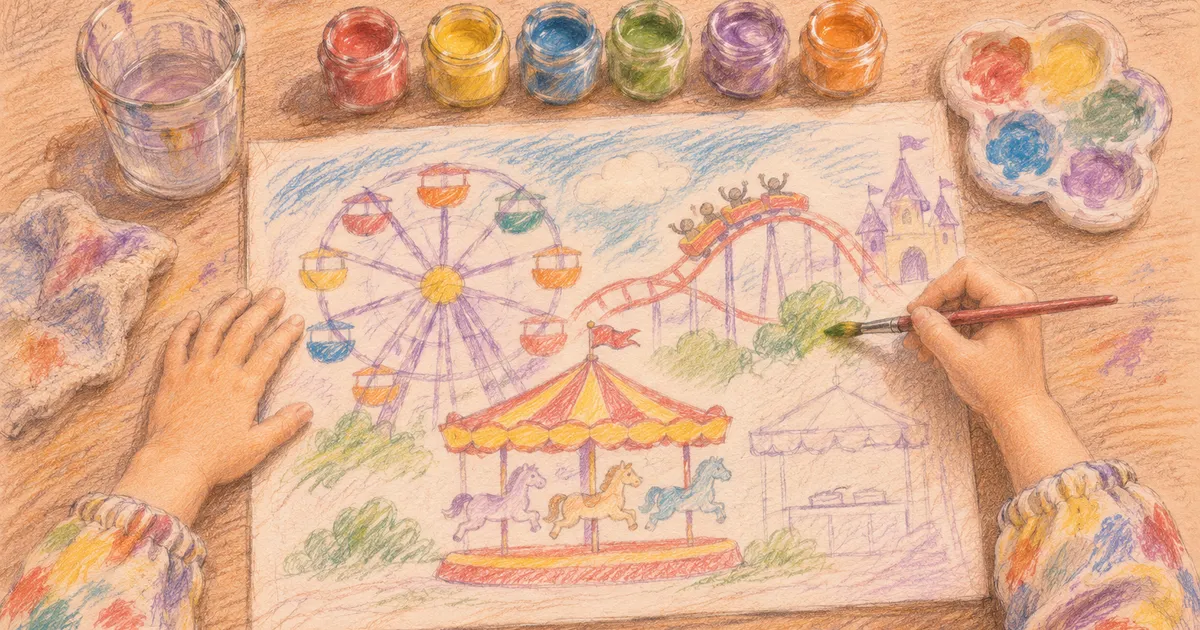
Amusement Park Words in English for Kids: Vocabulary and Activities covers ride, place, action, feeling, and safety language for a family outing. Start with six to ten words: ride, ticket, queue, carousel, fast, and excited. Build short phrases around each word. Pictures, toy figures, maps, and role-play support recall without teaching the full set at once. Focus first on understanding events, asking questions, and describing experiences—not perfect spelling.
📥 Amusement Park Words for Kids
Read, match, choose, and complete useful words and phrases for a family day out.
Leave your email — we'll send the PDF to your inbox.No spam — the PDF plus one short reminder. Unsubscribe anytime.
Essential Words for an Amusement Park Visit
Teach words in small, purposeful groups. Ride names support choices, action words explain instructions, and feeling words help children express excitement or discomfort.
Use Amusement Park Words in English for Kids: Vocabulary and Activities as a menu, not a checklist. Choose words linked to rides your child knows or expects to see. A child sensitive to loud places may need noisy, quiet, crowded, and break before every ride name.
Useful Phrases in Context
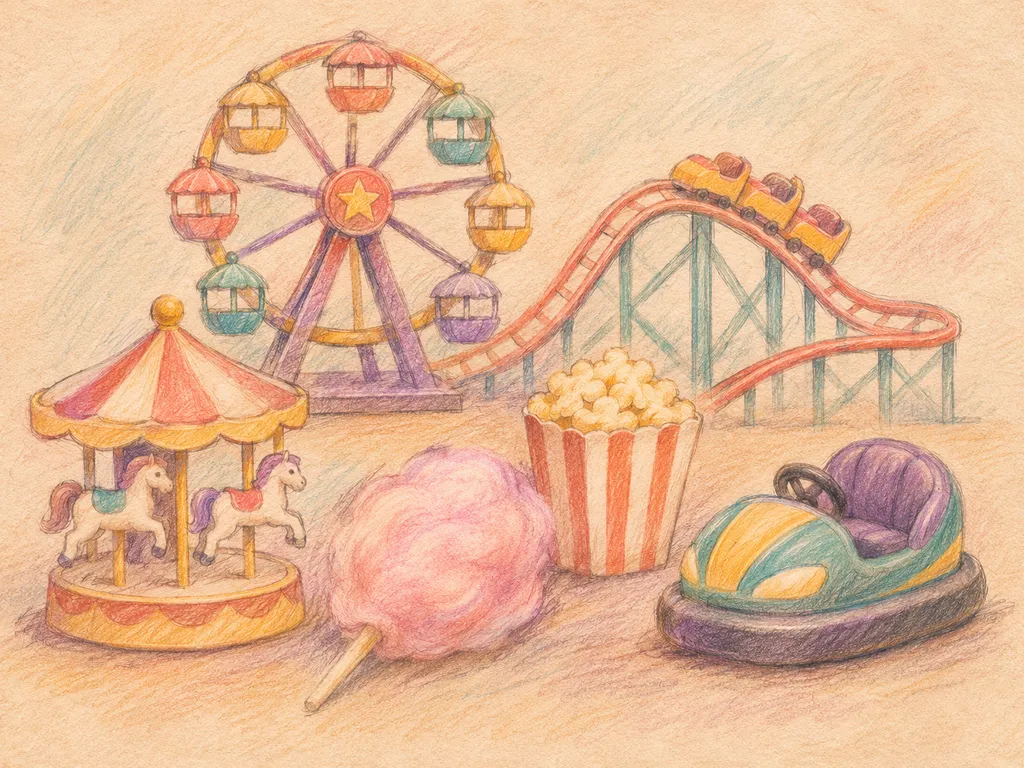
Single words provide a start; sentence frames make them usable. Keep the frame and change one part: “I want to ride the carousel,” “I want to ride the Ferris wheel,” or “I do not want to ride the roller coaster.”
Model an exchange instead of testing isolated words. Ask, “Which ride would you like?” The child answers, “I would like the carousel.” Afterward, ask, “How was it?” Answers might include “It was fun,” “It was too noisy,” or “I felt dizzy.”
Practise safety phrases: “I am lost,” “Please help me,” “Where is my parent?” and “I need a break.” Keep each phrase calm and direct. Explain that staff members can help if the family becomes separated.
How to Introduce the Vocabulary
When using Amusement Park Words in English for Kids: Vocabulary and Activities at home, begin with one park picture. Point, name, and pause: “roller coaster,” “ticket,” “queue.” Ask your child to point before speaking. Children often understand a word before producing it confidently.
Next, sort the words: rides in one group, feelings in another, and actions in a third. Multilingual children may answer first in another language. Accept the meaning, provide the English form, and invite one short repetition: “Yes, a ticket. We need a ticket.” Language switching is not failure.
Map and Ticket Role-play
Draw a basic park with an entrance, three rides, a food stall, and an exit. Give your child a paper ticket. Take turns playing visitor and staff member. Request a ride, follow a route, wait in a pretend queue, and describe the ride.
Finish with practical recall. Hide the picture and ask your child to name three rides or complete one sentence. Across LearnLink lessons, our tutors can reuse the words in questions, choices, and speaking games instead of teaching an isolated list.
Activities for Different Ages
School-age kids: Add movement and sound. Turn in a circle for carousel, move slowly for queue, and raise both hands for roller coaster. Show two picture cards and ask, “Carousel or bumper cars?” Accept one-word answers before modelling the full phrase.
School-age kids: Build a park from paper or blocks. Your child can make signs, sell pretend tickets, and give directions: “Go past the food stall. The Ferris wheel is next to the exit.” Add a feelings chart to compare rides as fun, scary, noisy, or calm.
School-age kids: Plan a fictional family visit with a map and time limit. The learner must agree on three rides, explain each choice, and solve a problem such as a long queue or closed attraction. Amusement Park Words in English for Kids: Vocabulary and Activities supports reasons, comparisons, and polite disagreement.
Practice Ideas That Fit Family Routines
Keep practice brief and spread it across several days. Amusement Park Words in English for Kids: Vocabulary and Activities becomes easier to retain when the language appears in different forms: a Monday picture, a Wednesday sorting game, and weekend role-play.
Before a visit, study a park map and let your child find the entrance, rides, food area, and exit. At the park, ask natural questions such as “Which ride is next?” Avoid constant translation tests. Afterward, use two photos to describe events in the past tense: “We waited,” “We rode,” and “We got wet.”
For a family game, place word cards face down. Each player turns over one card and uses it in a sentence. Younger children may say, “A fast ride.” Older children can add detail: “The roller coaster looked fast, so I chose the carousel instead.” Praise accurate meaning before correcting minor grammar slips.
Common Mistakes and Helpful Corrections
Children may say “I want ride” because other languages use different verb patterns. Model the missing word without a grammar lecture: “I want to ride.” For “I am exciting,” contrast the meanings: “The ride is exciting. You are excited.”
Ride and rode can cause confusion. Use ride for the present or after want to: “We ride together” and “I want to ride.” Use rode for a finished event: “We rode the Ferris wheel yesterday.” Link each example to a picture or memory that marks the time.
Regional vocabulary differs. Queue appears in British English, while line appears in American English. Candyfloss and cotton candy name the same treat. Teach the form your child will probably hear, but recognise both. Neither variety is the only correct English.
- Choose five amusement park words and say each aloud together twice.
- Point to three ride pictures and ask your child to name them.
- Correct one mistake gently by repeating the full sentence with the right word.
- Compare two attractions using simple phrases such as faster, taller, or scarier.
- Finish with a three-word matching game using pictures and written labels.
When a word has several meanings or pronunciations, Cambridge Dictionary is a useful check before turning it into child-friendly examples.
Frequently Asked Questions
How Many Amusement Park Words Should My Child Learn at Once?
Begin with six to ten words for one situation, such as choosing a ride or buying a ticket. Amusement Park Words in English for Kids: Vocabulary and Activities should grow in small sets. Add words once your child understands the first set in a picture, question, or game without translating every item.
Should My Child Learn British or American Amusement Park Terms?
Start with the variety your child hears at school, online, or where the family lives. Then introduce alternatives such as queue and line or candyfloss and cotton candy. Both forms work. Your child should understand each term and use one form consistently within a sentence.
How Should I Correct Pronunciation Mistakes?
Repeat the word accurately within a natural reply instead of stopping for every sound. If your child pronounces roller coaster unclearly, answer, “Yes, the roller coaster looks fast.” Request another attempt only when listeners cannot understand the word. Calm modelling protects confidence and supplies an accurate form.
What If My Child Is Afraid of Amusement Park Rides?
Do not use English practice to push your child onto a ride. Teach phrases that provide control: “I feel scared,” “I do not want to go,” “Can we watch first?” and “I need a break.” Practise with maps, toy figures, videos, or pretend tickets. Expressing discomfort is a valuable language skill.
If your child needs steady speaking practice, start small — choose a trial lesson.
Stay updated on our latest tips and resources by following us on Instagram LearnLink.