Police Station Vocabulary for Kids
Police Station Vocabulary in English for Kids: Words and Activities covers 20 places, people, objects, and actions for children’s conversations. Begin with police officer, front desk, help, and report. Practise calm situations: finding a lost bag, describing an object, or asking where to wait. Crime stories are unnecessary. Examples, role-play, sorting, and recall tasks teach each word’s meaning and purpose.
Core Words Used at a Police Station
Teach one small group at a time. The table separates places and objects from people and actions, helping your child connect related terms.
Use Police Station Vocabulary in English for Kids: Words and Activities in two stages: learn each term, then speak it. Roles and building names vary by country, but these terms are widely understood. A witness reports what they noticed; witnessing does not mean causing the event.
Short Phrases in Context
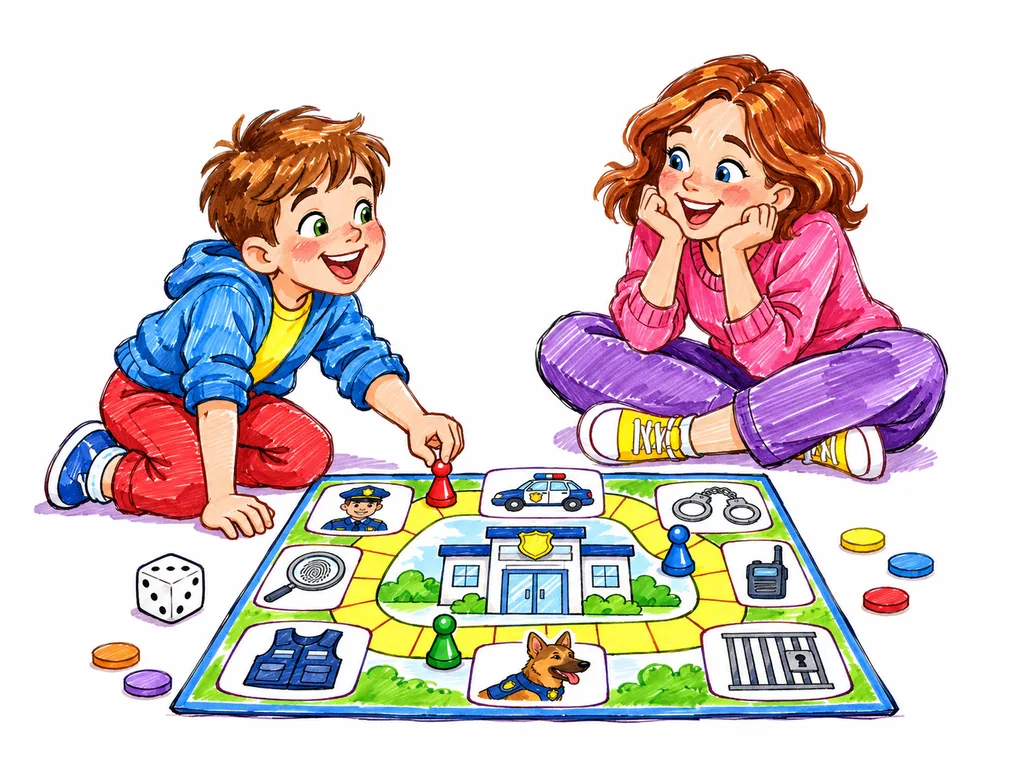
Build a six-line scene: “We are at the police station.” “I need help.” “I lost my backpack.” “What does it look like?” “It is small and green.” “Please wait by the front desk.” Read both roles, then let your child choose one. Allow time for accurate speech.
Change one detail per round. Replace the backpack with a coat, phone, bicycle, or toy; change its colour and size. Older children can add where and when they saw it: “I left it near the library at three o’clock.” This practises place and time language without a crime story.
Police Station Vocabulary in English for Kids: Words and Activities should teach safe communication. Practise stating a full name, naming a trusted adult, describing a lost item, and following directions. Never ask children to accuse real people or disclose private family details.
Activities for Different Ages
School-age kids: Sort pictures or toys into people, places, and objects. Ask, “Is this a badge or a radio?” and “Who works at the police station?” Use five or six words per round. Finish with a visitor requesting help and an officer giving directions.
School-age kids: Draw a station map with a front desk, waiting area, and office. Say, “Go to the front desk” or “Wait beside the chair.” Then role-play a lost-property report. Your child describes the item while an adult asks its colour, size, and last location.
School-age kids: Organise an event into four parts: what happened, where, when, and what the person noticed. Compare a spoken account with a written report. Discuss how police roles, uniforms, and emergency systems differ between countries without presenting one system as universal.
A Simple Practice Plan at Home
Keep Police Station Vocabulary in English for Kids: Words and Activities active through recall instead of copying. First, read and sort the terms. Next, hide the meanings and ask your child to explain or act out each item. Later, use five terms in a new scene. Review missed terms during the next round.
Quick Practice: Match the Clue
Ask your child to name the correct word without looking at the table.
- A person who saw an event
- The first place where a visitor asks for help
- Special clothes worn by an officer
- To say what an object looks like
- A written account of an event
Answers: witness, front desk, uniform, describe, report.
Follow with one speaking task: “You found a blue bag near a park. What would you say at the front desk?” Accept a short answer, then add details: “I found this blue bag near the park. I would like to report it.”
Common Mistakes and Calm Corrections
Police station terms follow distinct grammar rules. Model the complete phrase, then ask your child to repeat it. A short correction works better than a long lecture.
Model po-LEECE, stressing the second syllable. Teach the gender-neutral officer instead of defaulting to policeman. If your child confuses witness with suspect, explain: a witness noticed something; a suspect is under police investigation. Being a suspect does not prove guilt.
- Model one correct sentence, then invite your child to repeat it calmly.
- Choose five police station words and practice each with a simple picture.
- Read one short police story and pause to correct vocabulary gently.
- Replace blunt corrections with “Try that sentence again using officer or badge.”
- Role-play two turns, praising accurate words before correcting one mistake.
When a word has several meanings or pronunciations, Cambridge Dictionary is a useful check before turning it into child-friendly examples.
Frequently Asked Questions
Which Police Station Words Should My Child Learn First?
Start with police station, police officer, front desk, help, wait, ask, answer, describe, report, and police car. Police Station Vocabulary in English for Kids: Words and Activities is easier when your child learns a small group, uses it in a scene, then adds two or three terms. Choose language they may encounter in a book, trip, or safety talk.
How Can Our Tutors Teach This Vocabulary Without Making My Child Anxious?
Choose calm situations such as finding a backpack or looking for a parent. Your child can play the visitor, officer, or narrator; no crime scene is needed. Families may have different experiences of police. Focus on requesting help, following directions, and describing events without frightening details.
Should My Child Learn the Local Emergency Number in English?
Yes, but teach the number used where your family lives or travels; numbers differ by country. Explain when to call, what to say, and why practice calls must never reach a real emergency line. Rehearse with a toy phone and an adult dispatcher. Keep the location accurate.
How Often Should We Practise These Words?
Schedule two or three brief sessions across a week. Review five to eight terms without showing the answers, then revisit mistakes next time. Stop before fatigue. Older children can write a four-sentence report; younger children can point, sort, and speak.
Finish with three actions: review five terms, role-play one six-line scene, and describe one lost object without prompts. Repeat twice during the week, then review any forgotten vocabulary.
Want to see how these ideas work in a real lesson — try a LearnLink trial lesson.
Stay updated on our latest tips and resources by following us on Instagram LearnLink.